UVF: The Endgame by Jim Cusack & Henry McDonald
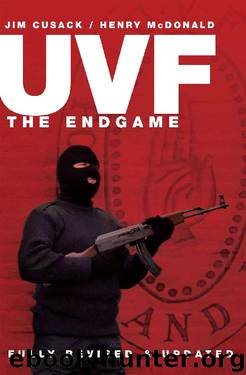
Author:Jim Cusack & Henry McDonald [Cusack, Jim & McDonald, Henry]
Language: eng
Format: epub
Tags: History, World, Politics & Social Sciences, Politics & Government, Elections & Political Process, Political Parties, Political Science, Constitutions
ISBN: 9781842233269
Google: a1P-LQAACAAJ
Publisher: Poolbeg Press
Published: 2008-09-14T23:00:00+00:00
Eight
JUST ANOTHER SELL-OUT
In their heart of hearts loyalists have always suspected that Britain has an exit strategy. They fear the mandarins at the Foreign Office are devising a long-term scheme to withdraw from Northern Ireland. The process starts with economic pull-out and slowly but surely, through giving Dublin a greater influence, the political link is severed. The long-held belief in a plot to disengage was bolstered on November 15, 1985, when Britain and the Republic signed the Anglo-Irish Agreement. Less than two years before, Margaret Thatcher had rejected the recommendations of the pan-nationalist Forum report with the infamous “Out, Out, Out,” dismissal. Now she was in the centre of British power in the North, Hillsborough Castle, signing the accord with the then Taoiseach, Garret FitzGerald.
In unionist eyes Thatcher had committed the ultimate turn-about by giving the Republic a say in the governance of a province she once said was as British as her own Finchley constituency. Another link in the chain connecting the North to the United Kingdom had been broken. In addition Britain was now declaring itself neutral, whereas the Republic’s government continued to sponsor Northern nationalism.
It is an axiom of Irish history that in times when the union was perceived to be under threat loyalist violence would increase. In the years following the Anglo-Irish Agreement, the index of murder and intimidation from both the UVF and UDA soared back up to levels not seen since the early to mid-1970s.
In the years just before the Agreement UVF violence had been severely curtailed. In the 1970s the organisation was killing scores of people, sometimes at least one a week, every year. By the early 1980s their murder rate was down to about four to five victims per annum. This was mainly due to the RUC’s use of the Supergrass system.
It was not an entirely new weapon for the police to deploy against terrorist organisations. The testimony of informers helped to convict more than twenty UVF activists in East Antrim in 1976. The crucial difference, however, was that the supergrass system allowed paramilitaries to be held solely on the uncorroborated evidence of informers, who betrayed their former comrades for immunity from prosecution or a sharp reduction in their sentences.
The first Supergrass was the Ardoyne IRA man, Christopher Black, who went on to implicate thirty-eight men he alleged were active Provos. Once Black began to bargain the signal was sent to other terrorists who also offered to help the police by selling out their colleagues. The first to turn Supergrass on the loyalist side was Clifford McKeown, a UVF man who agreed to give evidence against twenty-five men, mainly from the mid-Ulster area. They included a young loyalist from Portadown called Billy Wright. They were all held on serious charges including murder.
McKeown changed his mind in mid-July 1982 and refused to give any more evidence. The trial continued and eighteen of the men were eventually convicted, mainly on minor offences. More importantly, McKeown’s original decision to co-operate sparked a chain reaction among loyalist remand prisoners who started to offer themselves up as Supergrasses.
Download
This site does not store any files on its server. We only index and link to content provided by other sites. Please contact the content providers to delete copyright contents if any and email us, we'll remove relevant links or contents immediately.
| Anarchism | Communism & Socialism |
| Conservatism & Liberalism | Democracy |
| Fascism | Libertarianism |
| Nationalism | Radicalism |
| Utopian |
The Secret History by Donna Tartt(19084)
The Social Justice Warrior Handbook by Lisa De Pasquale(12190)
Thirteen Reasons Why by Jay Asher(8907)
This Is How You Lose Her by Junot Diaz(6885)
Weapons of Math Destruction by Cathy O'Neil(6279)
Zero to One by Peter Thiel(5801)
Beartown by Fredrik Backman(5751)
The Myth of the Strong Leader by Archie Brown(5507)
The Fire Next Time by James Baldwin(5442)
How Democracies Die by Steven Levitsky & Daniel Ziblatt(5218)
Promise Me, Dad by Joe Biden(5153)
Stone's Rules by Roger Stone(5087)
A Higher Loyalty: Truth, Lies, and Leadership by James Comey(4960)
100 Deadly Skills by Clint Emerson(4924)
Rise and Kill First by Ronen Bergman(4788)
Secrecy World by Jake Bernstein(4751)
The David Icke Guide to the Global Conspiracy (and how to end it) by David Icke(4717)
The Farm by Tom Rob Smith(4507)
The Doomsday Machine by Daniel Ellsberg(4490)
